LOSE WEIGHT WITH MEDICAL SUPPORT — BUILT FOR MEN
- Your personalised programme is built around medical care, not willpower.
- No generic diets. No guesswork.
- Just science-backed results and expert support.
Find out if you’re eligible




Traveling internationally with weight loss injections like semaglutide (Wegovy, Ozempic) and tirzepatide (Zepbound, Mounjaro) is generally permissible but requires careful advance planning. These glucagon-like peptide-1 (GLP-1) receptor agonists and dual GIP/GLP-1 medications are temperature-sensitive biologics that need proper storage, documentation, and compliance with varying international regulations. Patients must navigate TSA requirements, destination country laws, and temperature control challenges while maintaining their treatment regimen. With appropriate preparation—including obtaining physician letters, researching country-specific restrictions, and using insulated travel cases—patients can safely transport these injectable medications abroad. This guide provides essential information for healthcare providers counseling patients on international travel with weight loss injections.
Quick Answer: You can take weight loss injections abroad with proper planning, documentation, and adherence to both TSA regulations and destination country requirements.
We offer compounded medications and Zepbound®. Compounded medications are prepared by licensed pharmacies and are not FDA-approved. References to Wegovy®, Ozempic®, Rybelsus®, Mounjaro®, or Saxenda®, or other GLP-1 brands, are informational only. Compounded and FDA-approved medications are not interchangeable.
Weight loss injections, particularly glucagon-like peptide-1 (GLP-1) receptor agonists such as semaglutide (Wegovy for weight management, Ozempic for type 2 diabetes) and tirzepatide (a dual GIP/GLP-1 receptor agonist marketed as Zepbound for weight management and Mounjaro for type 2 diabetes), have become increasingly prescribed medications. These medications work by mimicking incretin hormones that regulate appetite and glucose metabolism, leading to reduced caloric intake and sustained weight loss. As more patients rely on these weekly injections, questions about traveling internationally with these medications have become clinically relevant.
Traveling abroad with weight loss injections is generally permissible, but requires careful planning and adherence to both domestic and international regulations. The primary considerations include proper documentation, temperature-sensitive storage requirements, and varying legal frameworks across countries. Unlike oral medications, injectable therapies present unique challenges due to their need for refrigeration and the presence of needles, which may raise security concerns.
Patients should begin travel preparations at least 4–6 weeks before departure. This timeline allows adequate time to obtain necessary documentation from prescribing physicians, research destination country regulations, and arrange appropriate storage solutions. The FDA-approved labeling for these medications does not specifically address international travel, but general principles for transporting temperature-sensitive biologics apply. Healthcare providers should counsel patients that while these medications are legal prescription drugs in the United States, their regulatory status varies significantly worldwide, and some countries may have restrictions or require additional documentation for entry.
Patients should be aware of symptoms requiring urgent medical attention while abroad, including severe abdominal pain, persistent vomiting, signs of dehydration, or symptoms of pancreatitis or gallbladder disease.
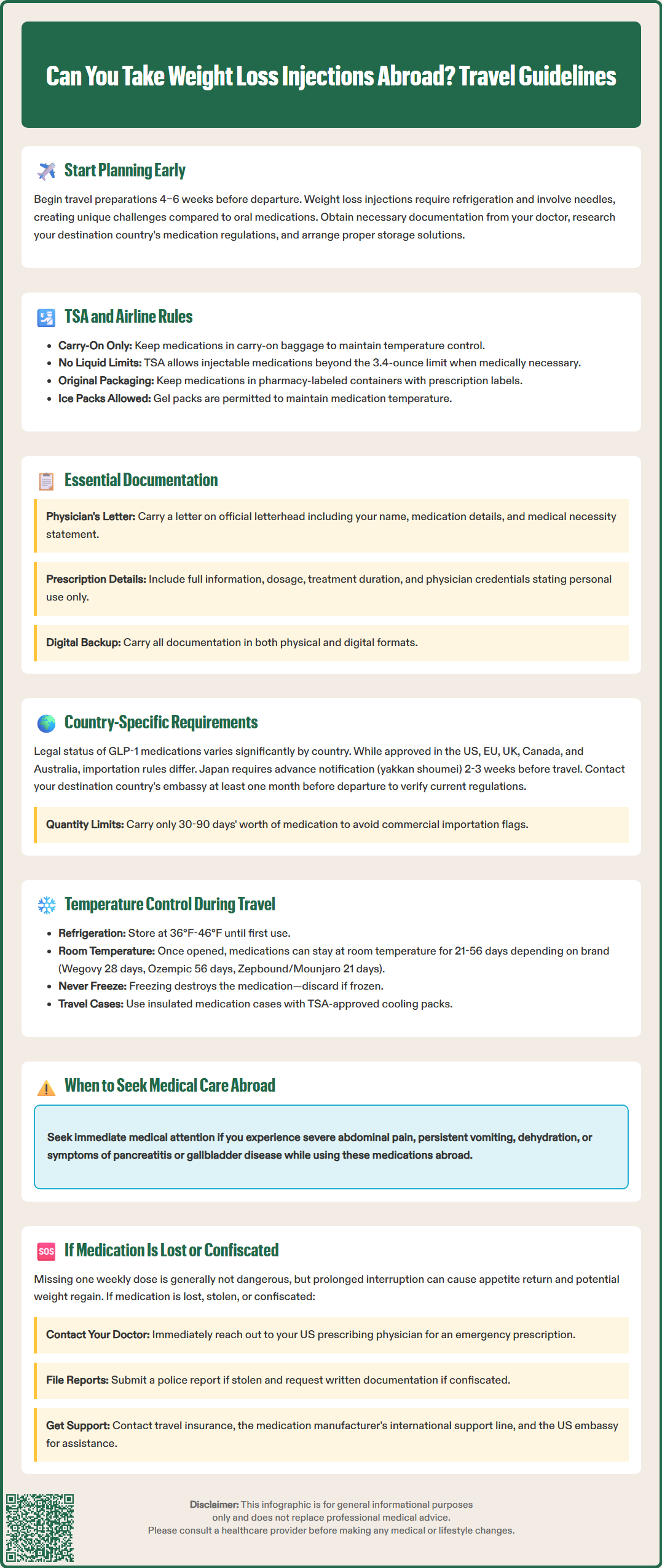
The Transportation Security Administration (TSA) permits passengers to carry medically necessary liquids, including injectable medications, in quantities exceeding the standard 3.4-ounce (100 milliliters) limit for carry-on luggage. Weight loss injections should always be transported in carry-on baggage rather than checked luggage to maintain temperature control and prevent loss. TSA guidelines allow syringes and needles when accompanied by injectable medication.
While not required, passengers may choose to voluntarily inform TSA officers about their injectable medications at the security checkpoint. Carrying a letter from the prescribing physician on official letterhead can facilitate the screening process. This letter should include the patient's name, medication name (both brand and generic), dosage, administration route, and a statement of medical necessity. While not required by TSA, keeping medication in its original pharmacy-labeled container or manufacturer packaging is recommended and may help verify its legitimacy in foreign countries.
For prefilled pens like Wegovy or Mounjaro, the original carton with prescription label is helpful for identification purposes. Patients should also carry alcohol swabs, sharps containers, and any necessary supplies. Key TSA considerations include:
Medications are subject to additional screening but are permitted in reasonable quantities
Ice packs or gel packs for maintaining medication temperature are allowed through security checkpoints and may be partially thawed when used for medically necessary items
Consider using the TSA Cares helpline (855-787-2227) for assistance with medical items
The TSA Disability Notification Card can be used to discreetly inform officers about medical needs
Airline-specific policies may vary slightly, so patients should contact their carrier directly before travel. Most major US airlines align with TSA guidelines but may have specific documentation preferences for international flights.
LOSE WEIGHT WITH MEDICAL SUPPORT — BUILT FOR MEN
Find out if you’re eligible

The legal status of GLP-1 receptor agonists and dual GIP/GLP-1 receptor agonists varies considerably across international jurisdictions, and patients must research specific requirements for their destination countries. While these medications are approved in the United States, European Union, United Kingdom, Canada, and Australia, some countries classify them differently or restrict importation of injectable medications regardless of prescription status. There is no universal international framework governing personal medication importation.
Patients should obtain a detailed prescription letter from their healthcare provider that includes:
Patient's full name and date of birth
Medication name (generic and brand)
Dosage and administration instructions
Duration of treatment
Physician's contact information and medical license number
Statement that medication is for personal use only
Some countries require prescriptions to be translated into the local language by a certified translator, notarized, or authenticated by a consulate. The quantity of medication should be reasonable for the trip duration—typically limited to 30-90 days depending on the country. Carrying excessive quantities may raise suspicions of commercial importation or distribution.
Countries with known restrictions or additional requirements include:
Japan: Requires advance notification (yakkan shoumei) for quantities exceeding a 1-month supply or for bringing needles/injection devices; process takes 2–3 weeks
United Arab Emirates: Strict regulations for controlled substances; GLP-1 medications generally permitted with proper documentation
Singapore: Requires original prescription and limits quantities to personal use
China: Complex importation rules; some medications prohibited
Patients should contact the embassy or consulate of their destination country at least one month before travel to verify current regulations. The US State Department website provides contact information for foreign embassies, and many countries maintain dedicated customs or health ministry websites with medication importation guidelines. Documentation should be carried in both physical and digital formats.
Shipping or mailing prescription medications across international borders is generally not recommended due to customs restrictions and potential seizure.
GLP-1 and GIP/GLP-1 receptor agonists require refrigeration between 36°F and 46°F (2°C to 8°C) until first use. Once in use, most can tolerate room temperature (up to 86°F or 30°C) for limited periods that vary by product:
Wegovy (semaglutide): 28 days at room temperature
Ozempic (semaglutide): 56 days at room temperature
Zepbound/Mounjaro (tirzepatide): 21 days at room temperature
Maintaining proper temperature during international travel is critical to preserve medication efficacy. These medications should never be frozen, and if frozen, must be discarded. Exposure to extreme temperatures can denature the peptide structure and render the medication ineffective.
For air travel, patients should use insulated medication travel cases specifically designed for injectable biologics. These cases typically include reusable ice packs or gel packs that maintain appropriate temperature ranges for 8–12 hours. Temperature management strategies include:
Use insulated medication travel cases with cooling packs (these are permitted through TSA checkpoints when used for medication)
Consider battery-powered medication coolers for extended travel
Never place medications in checked baggage where temperatures fluctuate dramatically
Request refrigerator access at hotels in advance
Use digital temperature monitors to verify storage conditions
Protect medication from direct sunlight
Upon arrival at accommodations, medications should be immediately transferred to a refrigerator. Most hotels can provide refrigerator access upon request, and some offer in-room medical refrigerators for guests with medical needs. If refrigeration is unavailable, unopened pens can typically remain at room temperature for the duration specified in the product labeling, but patients should verify this with their pharmacist before travel.
Patients should inspect their medication before each use for any changes in appearance, such as discoloration, cloudiness, or particulate matter. If the medication appears altered or if there is uncertainty about temperature exposure, it should not be used. Carrying a backup dose when possible provides additional security, though this must be balanced against quantity restrictions in some countries.
For weekly injections, patients may need to adjust their injection day due to time zone changes. According to FDA labeling, semaglutide can be administered up to 48 hours before the scheduled day, while tirzepatide requires at least 72 hours between doses.
Despite careful planning, medications may occasionally be lost, stolen, or confiscated during international travel. Patients should prepare contingency plans before departure to minimize health risks and treatment interruptions. While missing one weekly dose of a GLP-1 or GIP/GLP-1 receptor agonist is generally not medically dangerous, prolonged interruption can lead to return of appetite, potential weight regain, and in patients with type 2 diabetes, deterioration of glycemic control.
If medication is lost or stolen, patients should immediately contact their prescribing physician in the United States. Many providers can issue emergency prescriptions, though acceptance by international pharmacies varies significantly by country. The US embassy or consulate can provide lists of local English-speaking physicians and reputable pharmacies. Immediate steps include:
File a police report if medication was stolen (required for insurance claims)
Contact travel insurance provider if coverage includes medication replacement
Reach out to the medication manufacturer's international patient support line
Consult with a local physician who may be able to prescribe a temporary supply
If medication is confiscated by customs officials, patients should request written documentation explaining the reason and ask about appeal processes. In some cases, confiscation results from documentation issues that can be resolved with additional paperwork. The US embassy can provide consular assistance and help navigate local regulations, though they cannot override foreign customs laws.
For patients with type 2 diabetes using GLP-1 or GIP/GLP-1 agonists, missing doses may require temporary adjustment of other diabetes medications to maintain glycemic control. Patients should carry glucose monitoring supplies and know their target blood glucose ranges. More frequent blood glucose monitoring is essential if doses are missed.
Upon return to the United States, patients should contact their healthcare provider to discuss any missed doses and determine appropriate next steps. Resumption of therapy should follow FDA-approved labeling for each specific medication. After multiple missed doses, re-titration may be necessary according to the product's prescribing information. To mitigate risks of medication loss, consider risk-reduction strategies such as splitting supplies across different carry-on bags (when legally permitted) and maintaining digital copies of all medical documentation.
Yes, you should obtain a detailed prescription letter from your healthcare provider on official letterhead that includes your name, medication name (generic and brand), dosage, administration instructions, and a statement of medical necessity. Some countries may require this letter to be translated, notarized, or authenticated by a consulate.
No, weight loss injections should always be transported in carry-on baggage to maintain proper temperature control and prevent loss. These medications require refrigeration and can be damaged by the extreme temperature fluctuations in aircraft cargo holds.
Request written documentation explaining the reason for confiscation and ask about appeal processes. Contact the US embassy or consulate for assistance, reach out to your prescribing physician for an emergency prescription, and consult with a local physician who may be able to provide a temporary supply.
All medical content on this blog is created using reputable, evidence-based sources and is regularly reviewed for accuracy and relevance. While we strive to keep our content current with the latest research and clinical guidelines, it is intended for general informational purposes only.
This content is not a substitute for professional medical advice, diagnosis, or treatment. Always consult a licensed healthcare provider with any medical questions or concerns. Use of this information is at your own risk, and we are not liable for any outcomes resulting from its use.